
Apex IPS · White paper
Will the capital reset bring insurers back to securitisation? EIOPA is sceptical.
EIOPA doubts that lower capital charges alone will drive a significant increase in insurer investment. Richard Sarsfield examines why the 2027 reset warrants a fresh look at senior CLOs and securitised credit.
Richard Sarsfield · Apex IPS ·
Read the white paper
This white paper considers how the EU's revised treatment from 2027 changes the capital case for senior securitised credit. It sets that treatment beside observed spreads and practical portfolio uses for insurers.
In this paper
- The capital reset
- Observed spreads and gross RoC
- An investible European market
- Portfolio applications and the 2027 response
Read the white paper
Read page text
WHITE PAPER · INSURANCE INVESTMENT
Solvency II’s
securitisation
reset
Capital efficiency, observed spreads and the case for insurer allocations
Richard Sarsfield · 6 October 2026
Read page text
APEX IPS · WHITE PAPER
Solvency II’s securitisation reset
2
© 2026 Apex Insurance & Pension Solutions
01
The allocation case
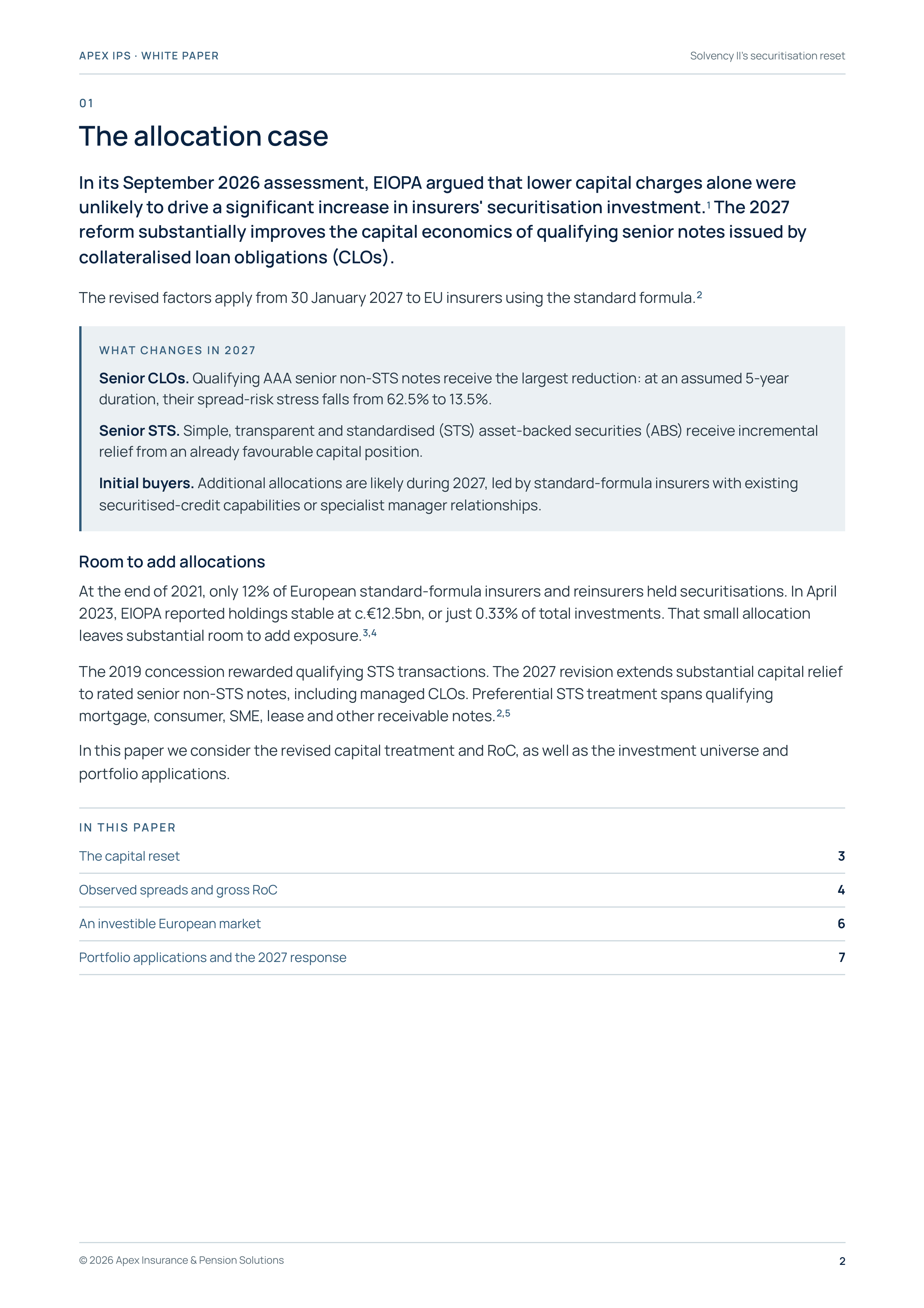
In its September 2026 assessment, EIOPA argued that lower capital charges alone were
unlikely to drive a significant increase in insurers' securitisation investment.1 The 2027
reform substantially improves the capital economics of qualifying senior notes issued by
collateralised loan obligations (CLOs).
The revised factors apply from 30 January 2027 to EU insurers using the standard formula.2
WHAT CHANGES IN 2027
Senior CLOs. Qualifying AAA senior non-STS notes receive the largest reduction: at an assumed 5-year
duration, their spread-risk stress falls from 62.5% to 13.5%.
Senior STS. Simple, transparent and standardised (STS) asset-backed securities (ABS) receive incremental
relief from an already favourable capital position.
Initial buyers. Additional allocations are likely during 2027, led by standard-formula insurers with existing
securitised-credit capabilities or specialist manager relationships.
Room to add allocations
At the end of 2021, only 12% of European standard-formula insurers and reinsurers held securitisations. In April
2023, EIOPA reported holdings stable at c.€12.5bn, or just 0.33% of total investments. That small allocation
leaves substantial room to add exposure.3,4
The 2019 concession rewarded qualifying STS transactions. The 2027 revision extends substantial capital relief
to rated senior non-STS notes, including managed CLOs. Preferential STS treatment spans qualifying
mortgage, consumer, SME, lease and other receivable notes.2,5
In this paper we consider the revised capital treatment and RoC, as well as the investment universe and
portfolio applications.
IN THIS PAPER
The capital reset
3
Observed spreads and gross RoC
4
An investible European market
6
Portfolio applications and the 2027 response
7
Read page text
APEX IPS · WHITE PAPER
Solvency II’s securitisation reset
3
© 2026 Apex Insurance & Pension Solutions
02
The capital reset
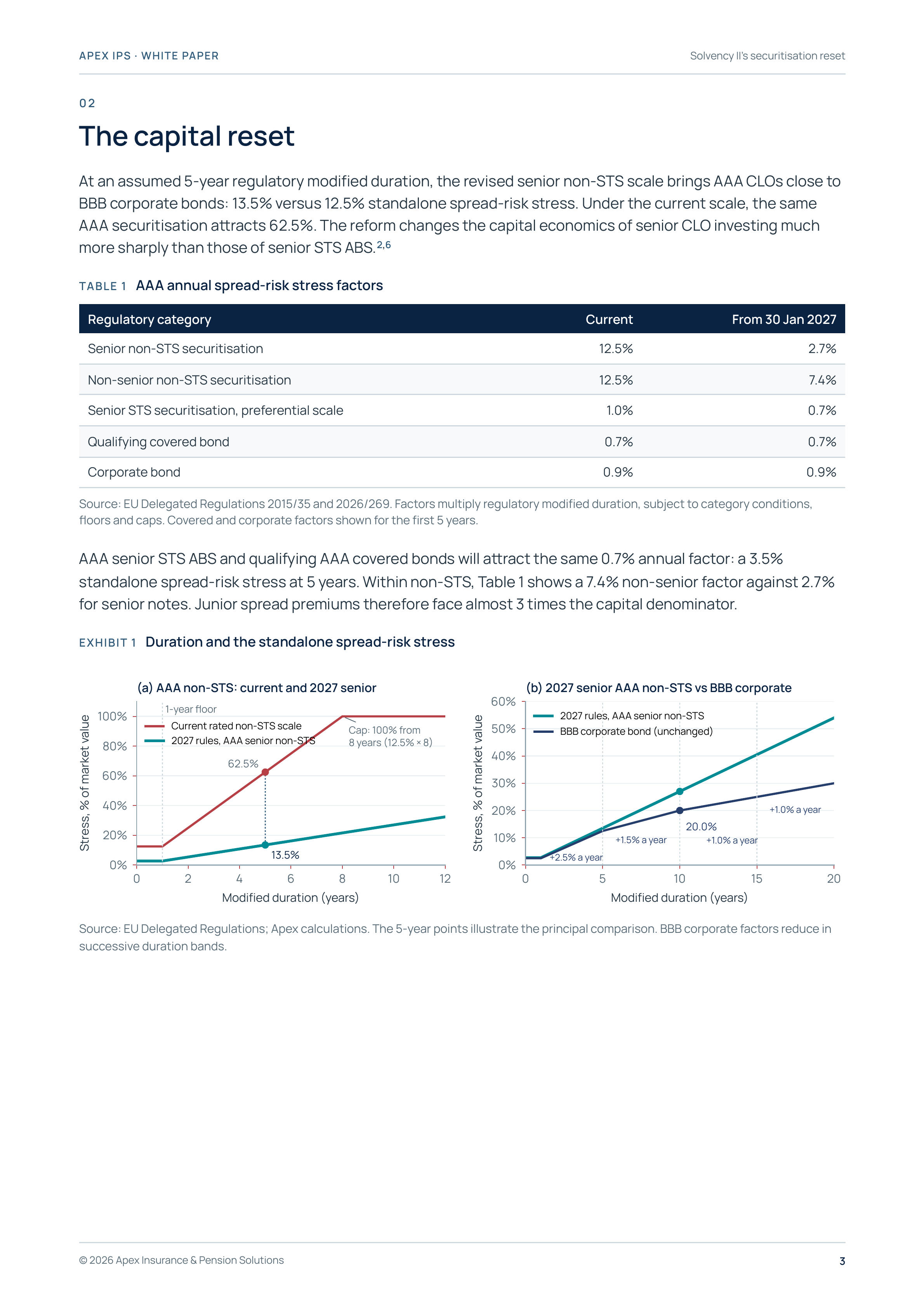
At an assumed 5-year regulatory modified duration, the revised senior non-STS scale brings AAA CLOs close to
BBB corporate bonds: 13.5% versus 12.5% standalone spread-risk stress. Under the current scale, the same
AAA securitisation attracts 62.5%. The reform changes the capital economics of senior CLO investing much
more sharply than those of senior STS ABS.2,6
TABLE 1 AAA annual spread-risk stress factors
Regulatory category
Current
From 30 Jan 2027
Senior non-STS securitisation
12.5%
2.7%
Non-senior non-STS securitisation
12.5%
7.4%
Senior STS securitisation, preferential scale
1.0%
0.7%
Qualifying covered bond
0.7%
0.7%
Corporate bond
0.9%
0.9%
Source: EU Delegated Regulations 2015/35 and 2026/269. Factors multiply regulatory modified duration, subject to category conditions,
floors and caps. Covered and corporate factors shown for the first 5 years.
AAA senior STS ABS and qualifying AAA covered bonds will attract the same 0.7% annual factor: a 3.5%
standalone spread-risk stress at 5 years. Within non-STS, Table 1 shows a 7.4% non-senior factor against 2.7%
for senior notes. Junior spread premiums therefore face almost 3 times the capital denominator.
EXHIBIT 1 Duration and the standalone spread-risk stress
0
2
4
6
8
10
12
Modified duration (years)
0%
20%
40%
60%
80%
100%
Stress, % of market value
1-year floor
62.5%
13.5%
Cap: 100% from
8 years (12.5% × 8)
(a) AAA non-STS: current and 2027 senior
Current rated non-STS scale
2027 rules, AAA senior non-STS
0
5
10
15
20
Modified duration (years)
0%
10%
20%
30%
40%
50%
60%
Stress, % of market value
+2.5% a year
+1.5% a year
+1.0% a year
+1.0% a year
20.0%
(b) 2027 senior AAA non-STS vs BBB corporate
2027 rules, AAA senior non-STS
BBB corporate bond (unchanged)
Source: EU Delegated Regulations; Apex calculations. The 5-year points illustrate the principal comparison. BBB corporate factors reduce in
successive duration bands.
Read page text
APEX IPS · WHITE PAPER
Solvency II’s securitisation reset
4
© 2026 Apex Insurance & Pension Solutions
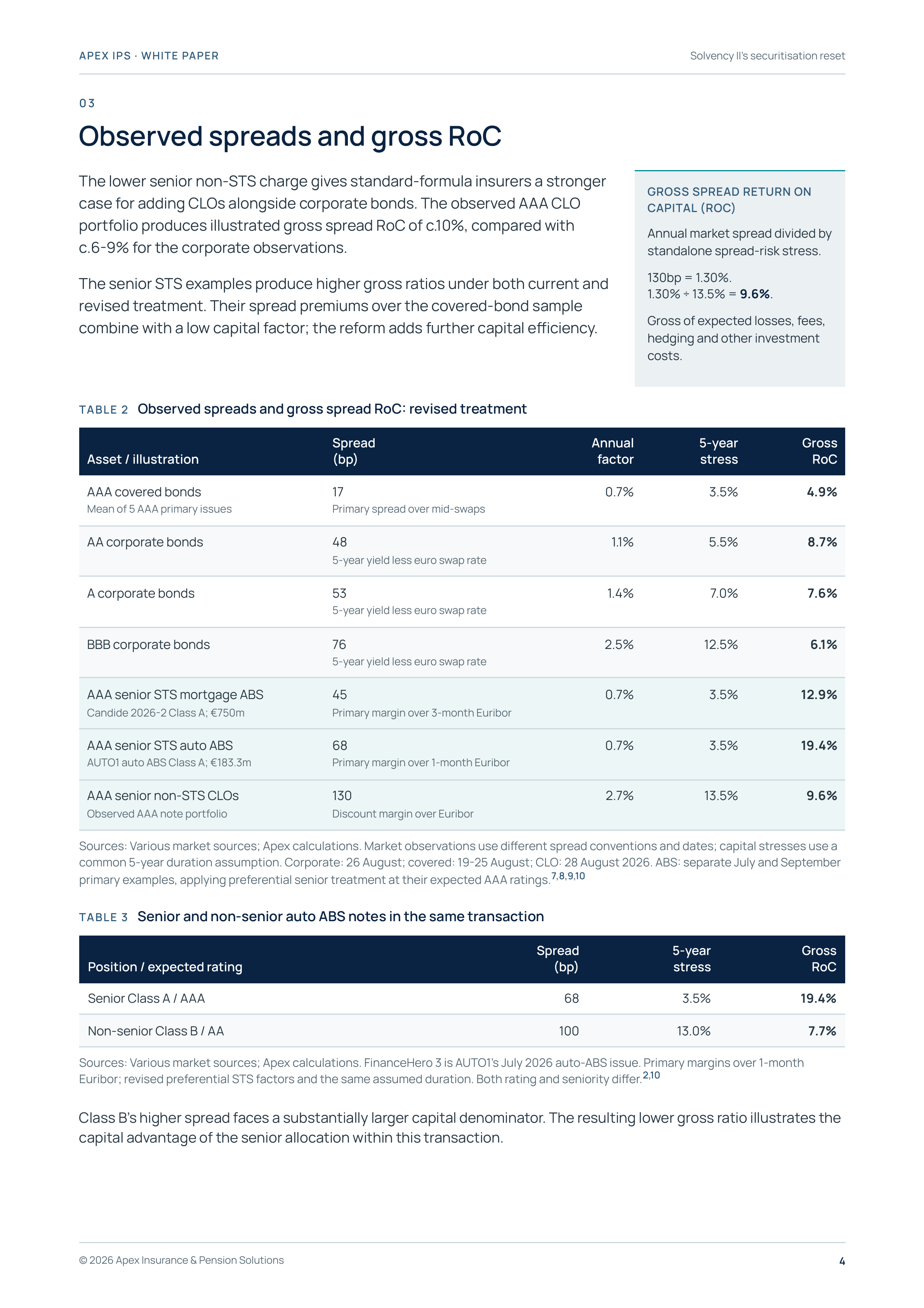
GROSS SPREAD RETURN ON
CAPITAL (ROC)
Annual market spread divided by
standalone spread-risk stress.
130bp = 1.30%.
1.30% ÷ 13.5% = 9.6%.
Gross of expected losses, fees,
hedging and other investment
costs.
03
Observed spreads and gross RoC
The lower senior non-STS charge gives standard-formula insurers a stronger
case for adding CLOs alongside corporate bonds. The observed AAA CLO
portfolio produces illustrated gross spread RoC of c.10%, compared with
c.6-9% for the corporate observations.
The senior STS examples produce higher gross ratios under both current and
revised treatment. Their spread premiums over the covered-bond sample
combine with a low capital factor; the reform adds further capital efficiency.
TABLE 2 Observed spreads and gross spread RoC: revised treatment
Asset / illustration
Spread
(bp)
Annual
factor
5-year
stress
Gross
RoC
AAA covered bonds
Mean of 5 AAA primary issues
17
Primary spread over mid-swaps
0.7%
3.5%
4.9%
AA corporate bonds
48
5-year yield less euro swap rate
1.1%
5.5%
8.7%
A corporate bonds
53
5-year yield less euro swap rate
1.4%
7.0%
7.6%
BBB corporate bonds
76
5-year yield less euro swap rate
2.5%
12.5%
6.1%
AAA senior STS mortgage ABS
Candide 2026-2 Class A; €750m
45
Primary margin over 3-month Euribor
0.7%
3.5%
12.9%
AAA senior STS auto ABS
AUTO1 auto ABS Class A; €183.3m
68
Primary margin over 1-month Euribor
0.7%
3.5%
19.4%
AAA senior non-STS CLOs
Observed AAA note portfolio
130
Discount margin over Euribor
2.7%
13.5%
9.6%
Sources: Various market sources; Apex calculations. Market observations use different spread conventions and dates; capital stresses use a
common 5-year duration assumption. Corporate: 26 August; covered: 19-25 August; CLO: 28 August 2026. ABS: separate July and September
primary examples, applying preferential senior treatment at their expected AAA ratings.7,8,9,10
TABLE 3 Senior and non-senior auto ABS notes in the same transaction
Position / expected rating
Spread
(bp)
5-year
stress
Gross
RoC
Senior Class A / AAA
68
3.5%
19.4%
Non-senior Class B / AA
100
13.0%
7.7%
Sources: Various market sources; Apex calculations. FinanceHero 3 is AUTO1's July 2026 auto-ABS issue. Primary margins over 1-month
Euribor; revised preferential STS factors and the same assumed duration. Both rating and seniority differ.2,10
Class B's higher spread faces a substantially larger capital denominator. The resulting lower gross ratio illustrates the
capital advantage of the senior allocation within this transaction.
Read page text
APEX IPS · WHITE PAPER
Solvency II’s securitisation reset
5
© 2026 Apex Insurance & Pension Solutions
03 CONTINUED
Two distinct investment cases
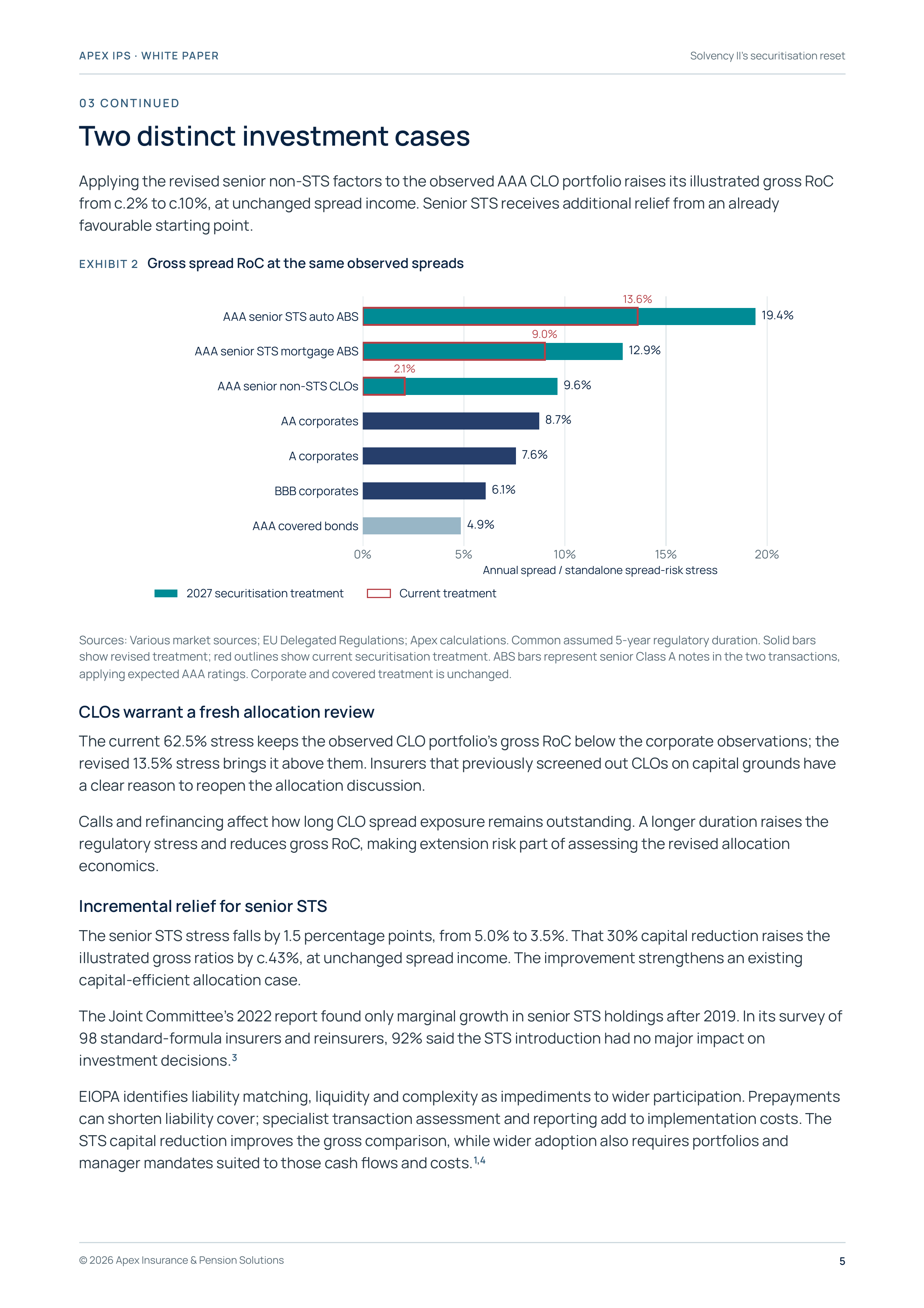
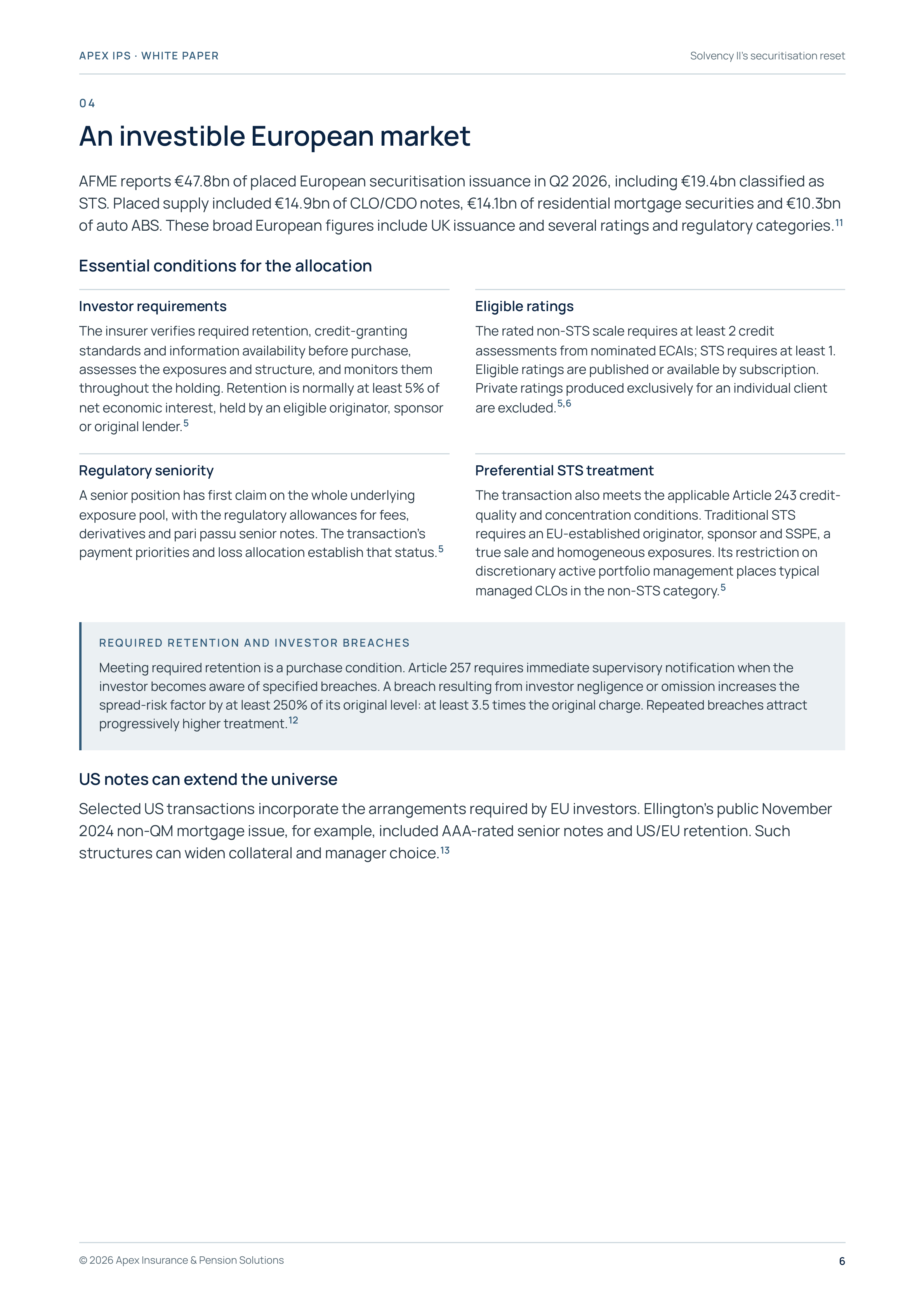
Applying the revised senior non-STS factors to the observed AAA CLO portfolio raises its illustrated gross RoC
from c.2% to c.10%, at unchanged spread income. Senior STS receives additional relief from an already
favourable starting point.
EXHIBIT 2 Gross spread RoC at the same observed spreads
0%
5%
10%
15%
20%
Annual spread / standalone spread-risk stress
AAA senior STS auto ABS
AAA senior STS mortgage ABS
AAA senior non-STS CLOs
AA corporates
A corporates
BBB corporates
AAA covered bonds
19.4%
12.9%
9.6%
8.7%
7.6%
6.1%
4.9%
2027 securitisation treatment
Current treatment
13.6%
9.0%
2.1%
Sources: Various market sources; EU Delegated Regulations; Apex calculations. Common assumed 5-year regulatory duration. Solid bars
show revised treatment; red outlines show current securitisation treatment. ABS bars represent senior Class A notes in the two transactions,
applying expected AAA ratings. Corporate and covered treatment is unchanged.
CLOs warrant a fresh allocation review
The current 62.5% stress keeps the observed CLO portfolio's gross RoC below the corporate observations; the
revised 13.5% stress brings it above them. Insurers that previously screened out CLOs on capital grounds have
a clear reason to reopen the allocation discussion.
Calls and refinancing affect how long CLO spread exposure remains outstanding. A longer duration raises the
regulatory stress and reduces gross RoC, making extension risk part of assessing the revised allocation
economics.
Incremental relief for senior STS
The senior STS stress falls by 1.5 percentage points, from 5.0% to 3.5%. That 30% capital reduction raises the
illustrated gross ratios by c.43%, at unchanged spread income. The improvement strengthens an existing
capital-efficient allocation case.
The Joint Committee's 2022 report found only marginal growth in senior STS holdings after 2019. In its survey of
98 standard-formula insurers and reinsurers, 92% said the STS introduction had no major impact on
investment decisions.3
EIOPA identifies liability matching, liquidity and complexity as impediments to wider participation. Prepayments
can shorten liability cover; specialist transaction assessment and reporting add to implementation costs. The
STS capital reduction improves the gross comparison, while wider adoption also requires portfolios and
manager mandates suited to those cash flows and costs.1,4
Read page text
APEX IPS · WHITE PAPER
Solvency II’s securitisation reset
6
© 2026 Apex Insurance & Pension Solutions
04
An investible European market
AFME reports €47.8bn of placed European securitisation issuance in Q2 2026, including €19.4bn classified as
STS. Placed supply included €14.9bn of CLO/CDO notes, €14.1bn of residential mortgage securities and €10.3bn
of auto ABS. These broad European figures include UK issuance and several ratings and regulatory categories.11
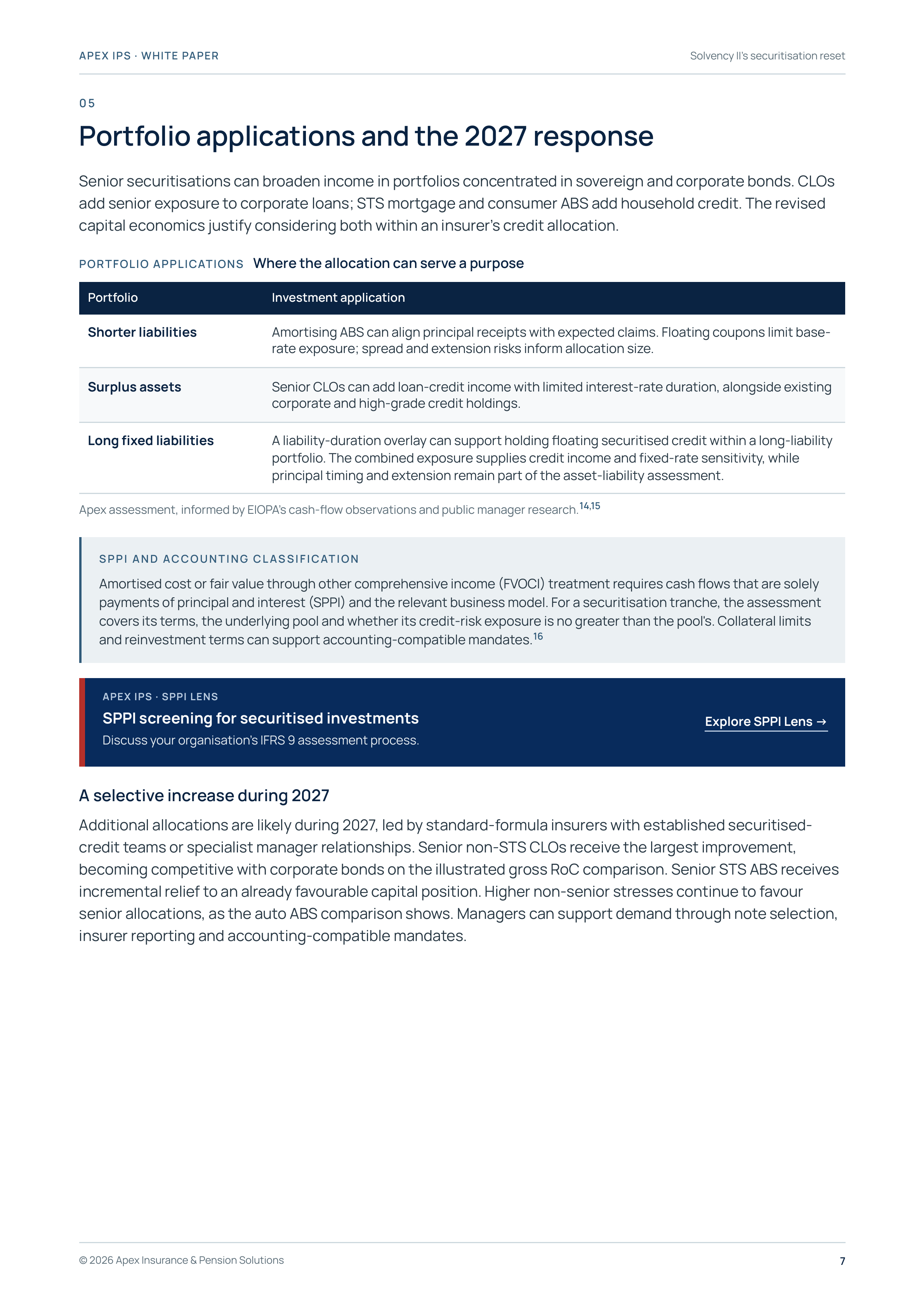
Essential conditions for the allocation
Investor requirements
The insurer verifies required retention, credit-granting
standards and information availability before purchase,
assesses the exposures and structure, and monitors them
throughout the holding. Retention is normally at least 5% of
net economic interest, held by an eligible originator, sponsor
or original lender.5
Eligible ratings
The rated non-STS scale requires at least 2 credit
assessments from nominated ECAIs; STS requires at least 1.
Eligible ratings are published or available by subscription.
Private ratings produced exclusively for an individual client
are excluded.5,6
Regulatory seniority
A senior position has first claim on the whole underlying
exposure pool, with the regulatory allowances for fees,
derivatives and pari passu senior notes. The transaction's
payment priorities and loss allocation establish that status.5
Preferential STS treatment
The transaction also meets the applicable Article 243 credit-
quality and concentration conditions. Traditional STS
requires an EU-established originator, sponsor and SSPE, a
true sale and homogeneous exposures. Its restriction on
discretionary active portfolio management places typical
managed CLOs in the non-STS category.5
REQUIRED RETENTION AND INVESTOR BREACHES
Meeting required retention is a purchase condition. Article 257 requires immediate supervisory notification when the
investor becomes aware of specified breaches. A breach resulting from investor negligence or omission increases the
spread-risk factor by at least 250% of its original level: at least 3.5 times the original charge. Repeated breaches attract
progressively higher treatment.12
US notes can extend the universe
Selected US transactions incorporate the arrangements required by EU investors. Ellington's public November
2024 non-QM mortgage issue, for example, included AAA-rated senior notes and US/EU retention. Such
structures can widen collateral and manager choice.13
Read page text
APEX IPS · WHITE PAPER
Solvency II’s securitisation reset
7
© 2026 Apex Insurance & Pension Solutions
05
Portfolio applications and the 2027 response
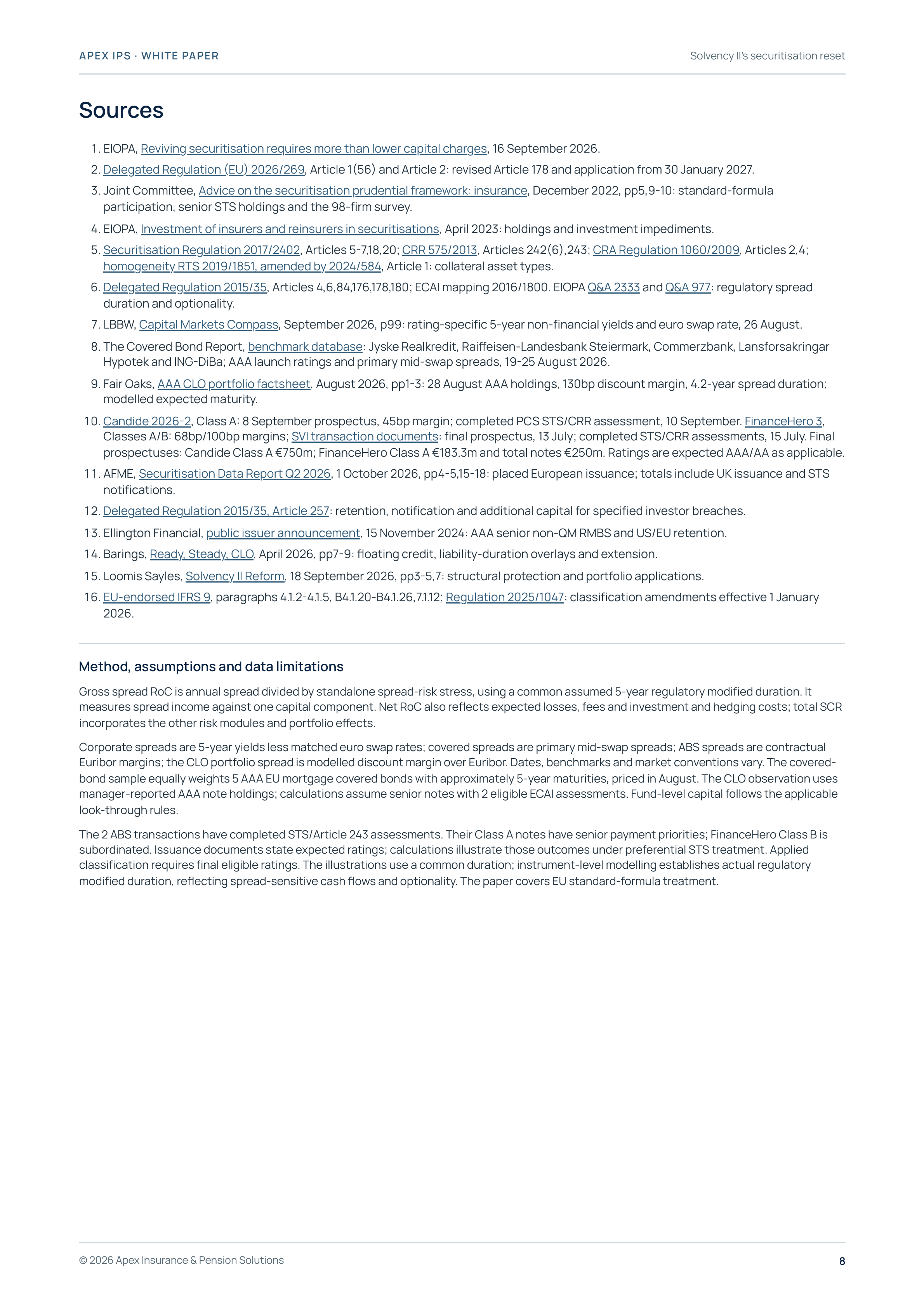
Senior securitisations can broaden income in portfolios concentrated in sovereign and corporate bonds. CLOs
add senior exposure to corporate loans; STS mortgage and consumer ABS add household credit. The revised
capital economics justify considering both within an insurer's credit allocation.
PORTFOLIO APPLICATIONS Where the allocation can serve a purpose
Portfolio
Investment application
Shorter liabilities
Amortising ABS can align principal receipts with expected claims. Floating coupons limit base-
rate exposure; spread and extension risks inform allocation size.
Surplus assets
Senior CLOs can add loan-credit income with limited interest-rate duration, alongside existing
corporate and high-grade credit holdings.
Long fixed liabilities
A liability-duration overlay can support holding floating securitised credit within a long-liability
portfolio. The combined exposure supplies credit income and fixed-rate sensitivity, while
principal timing and extension remain part of the asset-liability assessment.
Apex assessment, informed by EIOPA's cash-flow observations and public manager research.14,15
SPPI AND ACCOUNTING CLAS SIFICATION
Amortised cost or fair value through other comprehensive income (FVOCI) treatment requires cash flows that are solely
payments of principal and interest (SPPI) and the relevant business model. For a securitisation tranche, the assessment
covers its terms, the underlying pool and whether its credit-risk exposure is no greater than the pool's. Collateral limits
and reinvestment terms can support accounting-compatible mandates.16
APEX IPS · SPPI LENS
SPPI screening for securitised investments
Discuss your organisation's IFRS 9 assessment process.
Explore SPPI Lens →
A selective increase during 2027
Additional allocations are likely during 2027, led by standard-formula insurers with established securitised-
credit teams or specialist manager relationships. Senior non-STS CLOs receive the largest improvement,
becoming competitive with corporate bonds on the illustrated gross RoC comparison. Senior STS ABS receives
incremental relief to an already favourable capital position. Higher non-senior stresses continue to favour
senior allocations, as the auto ABS comparison shows. Managers can support demand through note selection,
insurer reporting and accounting-compatible mandates.
Read page text
APEX IPS · WHITE PAPER
Solvency II’s securitisation reset
8
© 2026 Apex Insurance & Pension Solutions
Sources
1. EIOPA, Reviving securitisation requires more than lower capital charges, 16 September 2026.
2. Delegated Regulation (EU) 2026/269, Article 1(56) and Article 2: revised Article 178 and application from 30 January 2027.
3. Joint Committee, Advice on the securitisation prudential framework: insurance, December 2022, pp5,9-10: standard-formula
participation, senior STS holdings and the 98-firm survey.
4. EIOPA, Investment of insurers and reinsurers in securitisations, April 2023: holdings and investment impediments.
5. Securitisation Regulation 2017/2402, Articles 5-7,18,20; CRR 575/2013, Articles 242(6),243; CRA Regulation 1060/2009, Articles 2,4;
homogeneity RTS 2019/1851, amended by 2024/584, Article 1: collateral asset types.
6. Delegated Regulation 2015/35, Articles 4,6,84,176,178,180; ECAI mapping 2016/1800. EIOPA Q&A 2333 and Q&A 977: regulatory spread
duration and optionality.
7. LBBW, Capital Markets Compass, September 2026, p99: rating-specific 5-year non-financial yields and euro swap rate, 26 August.
8. The Covered Bond Report, benchmark database: Jyske Realkredit, Raiffeisen-Landesbank Steiermark, Commerzbank, Lansforsakringar
Hypotek and ING-DiBa; AAA launch ratings and primary mid-swap spreads, 19-25 August 2026.
9. Fair Oaks, AAA CLO portfolio factsheet, August 2026, pp1-3: 28 August AAA holdings, 130bp discount margin, 4.2-year spread duration;
modelled expected maturity.
10. Candide 2026-2, Class A: 8 September prospectus, 45bp margin; completed PCS STS/CRR assessment, 10 September. FinanceHero 3,
Classes A/B: 68bp/100bp margins; SVI transaction documents: final prospectus, 13 July; completed STS/CRR assessments, 15 July. Final
prospectuses: Candide Class A €750m; FinanceHero Class A €183.3m and total notes €250m. Ratings are expected AAA/AA as applicable.
11. AFME, Securitisation Data Report Q2 2026, 1 October 2026, pp4-5,15-18: placed European issuance; totals include UK issuance and STS
notifications.
12. Delegated Regulation 2015/35, Article 257: retention, notification and additional capital for specified investor breaches.
13. Ellington Financial, public issuer announcement, 15 November 2024: AAA senior non-QM RMBS and US/EU retention.
14. Barings, Ready, Steady, CLO, April 2026, pp7-9: floating credit, liability-duration overlays and extension.
15. Loomis Sayles, Solvency II Reform, 18 September 2026, pp3-5,7: structural protection and portfolio applications.
16. EU-endorsed IFRS 9, paragraphs 4.1.2-4.1.5, B4.1.20-B4.1.26,7.1.12; Regulation 2025/1047: classification amendments effective 1 January
2026.
Method, assumptions and data limitations
Gross spread RoC is annual spread divided by standalone spread-risk stress, using a common assumed 5-year regulatory modified duration. It
measures spread income against one capital component. Net RoC also reflects expected losses, fees and investment and hedging costs; total SCR
incorporates the other risk modules and portfolio effects.
Corporate spreads are 5-year yields less matched euro swap rates; covered spreads are primary mid-swap spreads; ABS spreads are contractual
Euribor margins; the CLO portfolio spread is modelled discount margin over Euribor. Dates, benchmarks and market conventions vary. The covered-
bond sample equally weights 5 AAA EU mortgage covered bonds with approximately 5-year maturities, priced in August. The CLO observation uses
manager-reported AAA note holdings; calculations assume senior notes with 2 eligible ECAI assessments. Fund-level capital follows the applicable
look-through rules.
The 2 ABS transactions have completed STS/Article 243 assessments. Their Class A notes have senior payment priorities; FinanceHero Class B is
subordinated. Issuance documents state expected ratings; calculations illustrate those outcomes under preferential STS treatment. Applied
classification requires final eligible ratings. The illustrations use a common duration; instrument-level modelling establishes actual regulatory
modified duration, reflecting spread-sensitive cash flows and optionality. The paper covers EU standard-formula treatment.

Read page text
ABOUT THE AUTHOR
Richard Sarsfield
Richard spent around ten years managing assets for Lloyd's
insurers and around ten years as International Head of
Insurance Solutions at Morgan Stanley Investment
Management. He supports insurers and asset managers with
investment strategy, capital and accounting considerations,
and insurance investment propositions.
Please be in touch to discuss the implications for your investment
portfolio or insurance investment proposition.
richardsarsfield@apexips.com
www.apexips.com
linkedin.com/in/richardsarsfield
Important information. For professional investors and insurance practitioners, for information and discussion. This paper presents the author's
analysis using the cited sources and stated assumptions. Illustrative figures are scenario calculations. Investment decisions require the investor's own
assessment and appropriate legal, accounting, regulatory and supervisory input. This paper provides no security recommendation or legal, tax,
accounting or regulatory opinion. Apex IPS supports insurers and asset managers and does not provide regulated investment services or arrange
investments. Third-party data remain the property of their owners.
Copyright. © 2026 Apex Insurance & Pension Solutions. All rights reserved. This paper may be shared in full and unchanged, with attribution. Brief
extracts from Apex's original content may be quoted with attribution. Other reproduction or adaptation requires prior written permission, except where
permitted by law. Third-party material remains subject to its ownership and licence terms. Permissions: richardsarsfield@apexips.com.
Image and font credits. Geometric facade: 家祺 汤, Pexels, used under the Pexels licence. Bodoni Moda and Manrope: SIL Open Font License.
© 2026 Apex Insurance & Pension Solutions
9
Richard Sarsfield is the founder and publisher of Insurance Asset News and runs Apex IPS. This paper is published by Apex IPS.